From July 3 to 5, 2025, the 19th Annual Conference of the International China Planning Society (IACP) will be held at Xiamen University. IACP is committed to building a bridge between planning researchers and practitioners in China and other countries, as well as providing a platform for academic and professional exchange and discussion in planning. As an institutional partner of IACP, the Lincoln Land Policy Institute and the Peking University-Lincoln Center jointly hosted a special forum on the afternoon of July 4 themed "Low-Carbon Urban Development and Planning."
As an international conference, this annual conference attracted listeners from all over the country, including Hong Kong, Macau, Taiwan, and some foreign countries, mainly university teachers and current students in related fields. The special forum invited four domestic low-carbon experts to deliver keynote speeches. Professor Zhang Chun chaired the forum.

Zhang Chun
The first speaker was Professor Zhang Chun from Beijing Jiaotong University, with the topic "Collaborative Carbon Reduction Between Transportation and Cities from a Diverse and Inclusive Perspective." First, Professor Zhang Chun introduced the necessity of cross-sector collaborative carbon reduction, stating that carbon reduction in the transportation sector is key to achieving the "dual carbon" goals. Then, taking transportation-oriented development (TOD) as an example, Professor Zhang Chun explains the mechanisms and effects of TOD on carbon reduction from the perspectives of regional, urban, and community dimensions, and uses Shenzhen as an example to illustrate the impact patterns of urban form on public transportation carbon reduction. Finally, Professor Zhang Chun also introduced some carbon reduction cases in the transportation sector of developing countries.

Lu Qiuyang
The second speaker was Lu Qiuyang, Senior Transportation Engineer at the Institute for Transportation and Development Policy (ITDP), whose speech was titled " The Green Answer for the Last Mile: How Electric Tricycles Are Reshaping the Capillaries of Low-Carbon Cities." Lu Qiuyang first introduced the concept of electric two- and three-wheelers and their contribution to reducing dependence on oil, proposing that electric two- and three-wheelers can be integrated with public transportation, replacing short-distance small car travel as an option for low-carbon urban transportation. At the same time, she believes that electric two- and three-wheelers also have significant economic and social benefits, providing affordable transportation and livelihood tools for vulnerable groups. Regarding the unclear definitions and increasing accidents faced by electric two- and three-wheelers, and safety hazards, Lu Qiuyang provided specific policy recommendations at both the national and municipal levels.

Liang Xiaohong
The third speaker was Liang Xiaohong, Senior Engineer at Beijing Transportation Development Research Institute, who gave a speechTitled "Practical Experience of Beijing's Sub-center for Low-Carbon City Development." She first briefly introduced the sub-center's profile, focusing on typical practices in low-carbon transportation development, including improving public transportation access, developing walking and bicycle slow commuting systems, and various measures to alleviate road traffic congestion. Finally, he proposed reflections on the future low-carbon development of the sub-center, emphasizing that fiscal pressure is increasing year by year, continuously optimizing the investment structure, prioritizing funding where the city needs it most, and discussed with participants the sustainability and necessity of building an internal circulation network for rail transit in the sub-center.

Liu Jingyi
The fourth speaker was Liu Jingyi, a policy researcher at Peking University-Lincoln Center, whose speech was titled"Contradictions and Coordination Strategies for Wind and Solar Land under the 'Dual Carbon' Goals." First, she discussed land constraints under large-scale wind power development goals, including scarce land resources, conflicts between wind and solar industrial land and arable land and ecological protection, incomplete supporting policies during the construction phase of wind and photovoltaic power projects, and illegal land use in wind and solar power projects. She then introduced the Nature Conservancy project "Proper Site Selection for Renewable Energy," the photovoltaic remediation project for abandoned mines in Chuzhou, Anhui, and Denmark's artificial energy island as case studies. Finally, she discussed solutions to conflicts between new energy and land use, including strengthening coordination between wind and photovoltaic projects and territorial spatial planning, promoting diversified development models in the industry, coordinating project design and construction, improving land policies for wind and solar industries, and strengthening industrial land security.
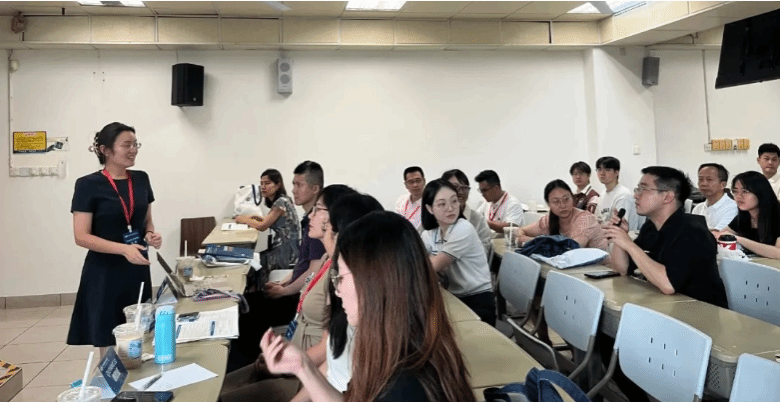
On site
Teachers and students actively asked questions on site, creating a lively atmosphere. Finally, Professor Zhang Chun concluded, expressing gratitude to all the experts and the attending teachers and students for their support of the event. The forum concluded successfully.

Group photo
Contributed by Liu Wei, Liu Xiuying, Li Wenjing, Li Yunhe
Photography by Li Yunhe
Proofread by Zhao Min