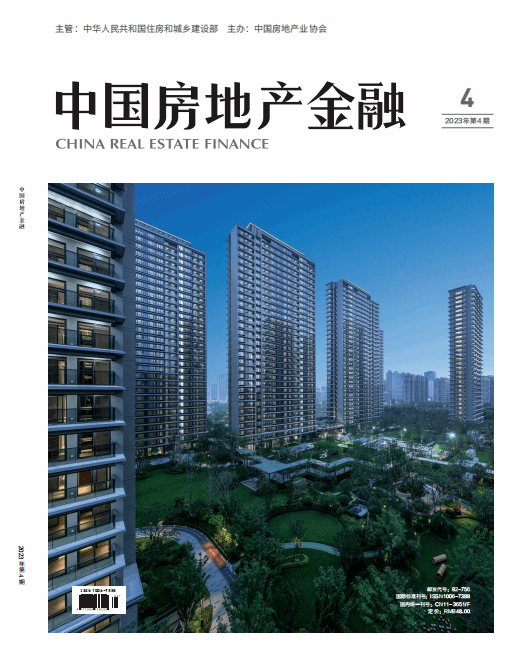
Since the housing reform in 1998, high-rise residential buildings have become the main product of commercial housing supply in China. Large-scale building volumes have now formed, and a batch of early-built high-rise residential buildings are about to enter the period of major repairs. High maintenance and demolition renewal costs have become urgent concerns. This paper analyzes the current development status and challenges of high-rise residential buildings in China, exploring full lifecycle management and maintenance mechanisms to improve maintenance and management levels and avoid or effectively address these issues. The preliminary research results were published in China Real Estate Finance, Issue 4, 2023. The authors are the research team from the Urban Development and Land Policy Research Center of Peking University–Lincoln Institute, including Liu Zhi, Liu Xiuying, Li Yunhe, and Liu Wei. During the research period, guidance was received from experts such as Feng Jun, Li Xiaojiang, Chen Yong, and Yi Chengdong. We would like to express our gratitude.
This paper first clarifies the definition of high-rise residential buildings, including "buildings with 7 floors or more, or residential buildings with a height greater than 24 meters," within the scope of research. With the acceleration of urbanization in China, and the contradictory effect of market demand and land resource shortages, more and more Chinese families are choosing to live in high-rise residences. The development of high-rise residential buildings also shows characteristics such as "an increasing proportion of residential buildings," "an increasing number of floors in buildings," and "the scale is most prominent in mega cities, with a significant proportion in small and medium-sized cities." Facing the dual pressures of "population aging and building aging," high-rise residential buildings face multiple challenges such as difficult management and maintenance difficulties, high costs, difficulty in renewing maintenance payments, and inconvenient access. Regarding the management and maintenance issues of high-rise residential buildings, the main recommendations proposed in this paper are as follows:
(1) Establish a full lifecycle management mechanism for high-rise residential buildings to extend their service life. Implement phased necessary management work for high-rise residential buildings, ensuring effective linkage at each stage to form a management chain. Specific content includes: inventory of high-rise residential stock, monitoring and risk warning of high-rise residential conditions, regular maintenance management, and renewal planning for high-rise residential buildings. The establishment of a full lifecycle management mechanism for high-rise residential buildings requires the joint participation and joint efforts of owners, property management, and the government, ultimately achieving a long-term mechanism for housing safety management.
(2) Improve the mechanism for depositing and operating maintenance funds for high-rise residential buildings to provide financial support for their maintenance. First, implement legal responsibilities for delayed or refusal to pay residential maintenance funds. For example, relevant departments can file and exercise lien rights for homeowners who have arrears, restrict the sale and inheritance of the property until the government recovers the outstanding payments, and prohibit the property from entering the market for transactions. Additionally, a flexible fund deposit mechanism can be established to avoid long-term accumulation and depreciation, while timely updating maintenance funding needs and reasonably using the dividends generated from operating funds.
(3) Explore the establishment of a housing pension system for high-rise residential buildings. Drawing on the multi-pillar pension system and housing provident fund system, establish China's housing pension system. The first pillar is the mandatory housing public pension. Its funds mainly come from special residential maintenance funds and local government fiscal funds, used to pay for daily basic and general repairs of houses in all residential communities citywide, as well as part of major repair costs. The second pillar is commercial housing pension insurance. Purchased voluntarily by community units, it is used to supplement the insufficient capacity of public housing pensions to pay for major housing repairs. The design of the housing pension system should emphasize bottom-up exploration to increase the enthusiasm of owners, property management, and other stakeholders in residential maintenance and management.
Promoting the longevity of residential buildings is an urgent task for solving the problem of existing residential use in China and the future development of housing. It is also a major task in shifting China's construction from resource-consuming to asset-sustaining. Therefore, improving the maintenance and management level of high-rise residential buildings is imperative, such as involving construction professionals, establishing mandatory maintenance mechanisms, standardizing property management practices, and strengthening government supervision and guidance. Through joint efforts, we aim to raise awareness and capabilities of maintenance and management of high-rise residential buildings across all sectors, achieve sustainable development of high-rise housing, and meet the public's demand for high-quality housing.
For detailed papers, see:
Research .pdf on the Full Lifecycle Management and Maintenance of High-rise Residential Buildings in China