This article is compiled from the thematic report "High-Quality Development, Carbon Neutrality, and Territorial Spatial Planning" at the Beijing Forum sub-forum on December 3, 2022, and has been reviewed by presenter Professor Guan Dabo.
Speakers:
Guan Dabo, Professor in the Department of Earth System Science at Tsinghua University, Fellow of the British Academy of Social Sciences, Fellow of the Royal Geographical Society, recipient of the 2018 Global 100 Most Influential Awards, the 2014 Cozzarelli Award from the Proceedings of the National Academy of Sciences, the Philip Leverhulme Award from the Leverhulme Trust in the UK, and Environmental Science & Technology Best Policy Paper of 2007, and the Leontief Best Paper Award in 2012 and 2013.
Professor Guan Dabo is dedicated to researching the causes, impacts, and countermeasures of climate change, analyzing the drivers of greenhouse gas emissions, and exploring global and national pathways for low-carbon and low-resource sustainable development.
Abstract:
This report introduces the China Carbon Accounting Database (CEADs) that are being built and operated, featuring independent intellectual property rights, comparable and verifiable, fully transparent and free, focusing on carbon accounting for developing economies worldwide. Its refined carbon emission accounting can achieve unified, comprehensive, verifiable high spatial accuracy across national, regional, and city scales, distinguishing social and economic sectors and energy product quality. Professor Guan presented annual reports on carbon dioxide emissions from emerging global economies and small and medium-sized developing economies based on relevant data. It also introduced the international community's progress in addressing climate change, as well as the connotations and pathways for China's carbon neutrality and carbon peaking.
1. Global Carbon Emission Background
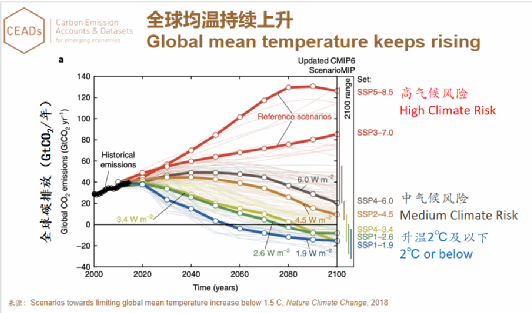
Everyone is talking about increasing global carbon emissions and global warming—what exactly is this trend?
First, since the Industrial Revolution, human society has released large amounts of carbon emissions into the atmosphere due to the burning of fossil fuels, causing the greenhouse effect. Since 2000, global emissions have surged at a rate of 3%-4% per year, and if this continues, global warming could reach 7-8°C by the end of this century. If the world can try to moderate, minimize, or reduce emissions, it may be possible to achieve the goal of keeping temperature rise by 2°C by the end of this century. If we start estimating roughly from 2020, there will be about 800 billion tons of carbon emissions globally over the next 80 years.
2. China Carbon Accounting Database
Currently, internationally accepted data sources are mainly European and American databases, with discourse power systems not controlled by developing countries like China. For many years, we have been committed to developing a database with independent intellectual property rights, which is comparable, fully transparent, and focused on developing country economies.

Construct a carbon emission inventory big data accounting method system that validates and couples "top-down" downscaled inventory with "bottom-up" emission point source big data. By organically connecting top-down national statistical and macro-level data with bottom-up micro-level point source and measured data, it achieves unified, comprehensive, verifiable high spatial accuracy across national, regional, and city scales, and refined carbon emission accounting that distinguishes social and economic sectors and energy product quality. Typical data include China's long-term series carbon emissions dataset, which breaks down 17 fossil fuels, 47 industry sectors, and more than 10 industrial product process emission datasets; Emerging economies carbon emissions–socioeconomic coupling data model, constructing a global socioeconomic trade model covering all 245 countries/regions, 135 industry sectors, and continuous time series worldwide.

3. Opportunities and Challenges in the Global Carbon Neutrality Transition
The fastest-growing countries in the world for carbon emissions include Myanmar, Laos, Zambia, and Nepal, whose carbon dioxide emission intensity has increased tenfold over the past decade, with GDP growth of 60-90%. Each of these countries accounts for a small share of global carbon emissions, yet together they are the third largest emitters globally. How to help these countries reduce emissions is a major challenge that will be faced in future climate change emission reductions. With the aim of achieving both poverty alleviation and sustainable development goals, is it possible to achieve a net-zero carbon transition to carbon emissions? At present, emissions in underdeveloped regions are unlikely to decline rapidly by at least 2050. Because they need emission space, other countries need more emission reductions. Developed countries, led by Europe and the United States, should reduce or even reduce emissions as soon as possible to make room for less developed regions.
4. Summary
The pandemic can be an opportunity for global structural emission reductions, but it may also be the beginning of retaliatory growth.
China's commitment to carbon neutrality by 2060 is an important contribution to global climate change emission reduction, with significance comparable to the impact of the three industrial revolutions on historical progress and social development;
The least developed small countries have enormous emission potential; pandemic lockdowns have slowed their emissions growth, but this does not prevent them from becoming the next "giants" of emissions overall;
In global climate governance, China should play a bridging role among developing economies, fully tap into the potential of small countries to reduce emissions, slow emissions, and reduce emissions, and embody the connotation and value of a "community with a shared future for mankind."
"Consensus and integrity" are the cornerstones of global climate change negotiations. The "integrity" guarantee system can be referenced by establishing a climate bailout mechanism under the United Nations' custody to enhance the stability of global climate governance.
Compiled by: Qi Fang