On the morning of November 5, 2022, the first event of the 15th Anniversary Series of the PKU-Lincoln Center, the online forum themed China’s Urbanization Pathways Under the Dual Carbon Goals: Cutting-Edge Reflections, was successfully held. Five renowned domestic and international scholars were invited to discuss core issues concerning China’s urbanization pathways amid the dual carbon targets from diverse perspectives.
Dr. Liu Zhi, Director of the PKU-Lincoln Center, presided over the online forum. The participating experts exchanged views on frontier research and practical practices of China’s urbanization pathways under the dual carbon goals covering green buildings, urban equity, urban agglomeration, urban-rural integration and other dimensions. The live broadcast via Tencent Meeting and Bilibili attracted more than 600 researchers specializing in urban science, land policy, spatial planning and related fields.

Dr. Liu Zhi, Director of the PKU-Lincoln Center, Presides Over the Forum
Opening the forum, Dr. Qiu Baoxing, Former Vice Minister of the Ministry of Housing and Urban-Rural Development, delivered a presentation titled Evolution and Future of Green Buildings. Dr. Qiu first introduced the definition, classification, evaluation criteria and common technical misconceptions of green buildings, and reviewed the evolutionary trajectory of green buildings as well as five developmental phases of green building practices in China. He then thoroughly analyzed core characteristics of green buildings including climate adaptability, diversity and full-life-cycle carbon reduction. Taking vertical landscape architecture — a future green building typology suited for southern China — as an example, he elaborated on the critical functions of green buildings in energy conservation, emission cuts and environmental improvement. In closing, Dr. Qiu summarized the key points of his report and prospected management mechanisms for green buildings as well as their applications in future scenarios such as old residential community renovation and consumption upgrading.

Dr. Qiu Baoxing, Former Vice Minister of the Ministry of Housing and Urban-Rural Development, Delivers His Presentation
Professor Zheng Siqi from the Department of Urban Studies and Planning, Massachusetts Institute of Technology, presented the report Commercial Building Decarbonization Model Accounting for Future Uncertainties. Professor Zheng illustrated the framework of her model from both supply-side and demand-side dimensions. The model incorporates the demand characteristics of developers, operators and tenants, and guides building electrification transition from the demand side through shared potential gains from building electrification among the three stakeholders. For market failure scenarios, the model also incorporates regulatory policies and capital injection from capital markets to drive building electrification on the supply side.
On the basis of the core model framework, Professor Zheng further analyzed risks arising from uncertainties in building electrification transition, including extra renovation costs, reduced financial returns, mismatches between urban energy transition and building electrification retrofits, and volatility of energy prices. Finally, she shared her team’s ongoing research trials in New York City. The team simulated three heating schemes — conventional gas heating, all-electric heating and flexible hybrid heating — via the model, and found that the flexible heating scheme delivers superior cost-benefit performance under all uncertainty scenarios. Professor Zheng concluded that building electrification transition must adopt more flexible implementation approaches amid uncertain risks.
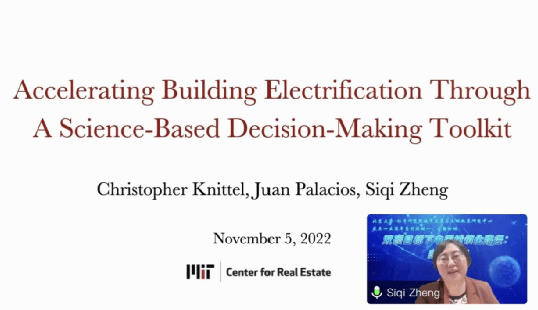
Professor Zheng Siqi, Department of Urban Studies and Planning, MIT, Delivers Her Presentation
The third presentation, Equity and Its Governance Under the Dual Carbon Goals, was delivered by Professor He Shenjing from the Department of Urban Planning and Design, the University of Hong Kong. Starting from an equity lens, Professor He interpreted the dual carbon targets, arguing that they are not merely environmental objectives but also political imperatives with profound socioeconomic ramifications and inherent equity and justice implications. Drawing on latest research findings, she unpacked disparities and equity-related issues under the dual carbon framework across four spatial scales: global north-south gaps, inter-regional and inter-city divides, intra-city inequalities, and urban-rural disparities.
In the final segment of her talk, Professor He elaborated on a social-ecological-technological governance framework and its corresponding pilot projects. Adopting the living lab model pioneered by MIT, the initiative explores pathways to deeply integrate dual carbon targets with technological progress, social justice and local culture, so as to jointly advance sustainable social development.

Professor He Shenjing, Department of Urban Planning and Design, University of Hong Kong, Delivers Her Presentation
Professor Lu Ming from the Antai College of Economics and Management, Shanghai Jiao Tong University, gave a speech titled Decarbonization Through Agglomeration: Environmental Effects of Unimpeded Domestic Economic Circulation. Adopting quantitative spatial general equilibrium analysis, Professor Lu’s research investigates the environmental impacts of smooth domestic circulation and unpacks the interplay between economic growth and carbon abatement, identifying pathways to achieve win-win outcomes for both development and emission reduction.
The study finds that spatial agglomeration of economic activities helps lower industrial pollution emission intensity per unit of GDP; population agglomeration generates scale effects in urban pollutant treatment and reduces per capita emissions. Professor Lu pointed out that under the institutional and policy backdrop of dual carbon targets and China’s economic transition, policy barriers hindering domestic circulation of production factors and commodities will impede cross-regional resource reallocation. Where certain regions enjoy scale economies in emissions and economic output yet cannot realize reallocation gains, both economic growth and efficiency will suffer. By contrast, unblocked domestic circulation enables economic agglomeration while delivering carbon reduction outcomes simultaneously.

Professor Lu Ming, Antai College of Economics and Management, Shanghai Jiao Tong University, Delivers His Presentation
Professor Liu Shouying from the School of Economics, Renmin University of China, presented the report Urban-Rural Integration and Rural Revitalization. Professor Liu noted that China’s rural development faces severe bottlenecks across four dimensions: population, industry, housing and land under the dual circulation strategy, making it urgent to forge a new type of urban-rural relationship and explore viable pathways for urban-rural integration.
First, outdated polarized mindsets must be abandoned, shifting from one-way urbanization to integrated progress of urbanization and rural construction. Second, integrated urban-rural zones should be developed as new spatial carriers. Third, land-centered reforms for rural factor allocation must be deepened, including optimized land functions and spatial layout at the metropolitan circle scale, alongside a unified national system of land rights and land markets covering both urban and rural areas.
Against the backdrop of persistent rural developmental bottlenecks, Professor Liu proposed four pathways to build a new urban-rural relationship and advance rural revitalization:
Industrialize agricultural production to boost land output per unit area;
Restructure rural land allocation centered on the three-rights separation reform of farmland, reallocation of collective construction land and homestead reform;
Attract population backflow and high-end talent to fuel rural revitalization;
Reshape village forms through targeted improvements to village landscapes, spatial boundaries, functional layouts, basic public services, elderly care systems and rural cultural heritage.

Professor Liu Shouying, School of Economics, Renmin University of China, Delivers Her Presentation
Closing the forum, Director Liu Zhi delivered concluding remarks and extended sincere gratitude to all guest speakers, participating scholars and the behind-the-scenes staff of the PKU-Lincoln Center. The Center will compile full transcripts of the expert presentations and release them via official WeChat articles on the PKU-Lincoln Center public account; readers are welcome to follow our subsequent updates.
Written by: Mu Enyi, Zhan Yanwei
Screenshot Editing: Mu Enyi
Revised by: Liu Xiuying
Reviewed & Approved by: Zhao Min