On the morning of November 6, 2020 (Beijing Time), the Sub-forum on Ecological Civilization and High-Quality Urbanization of the 2020 Beijing Forum, themed Civilization, Harmony and Common Prosperity, kicked off successfully at Yingjie Exchange Center, Peking University. The forum adopted a hybrid offline-online format and was broadcast live bilingually on Bilibili.
As an annual international academic conference co-hosted by Peking University, Beijing Municipal Education Commission and the Korea Foundation for Advanced Studies, this sub-forum was jointly organized by the School of Urban and Environmental Sciences, Peking University, and the Peking University–Lincoln Institute Center for Urban Development and Land Policy.
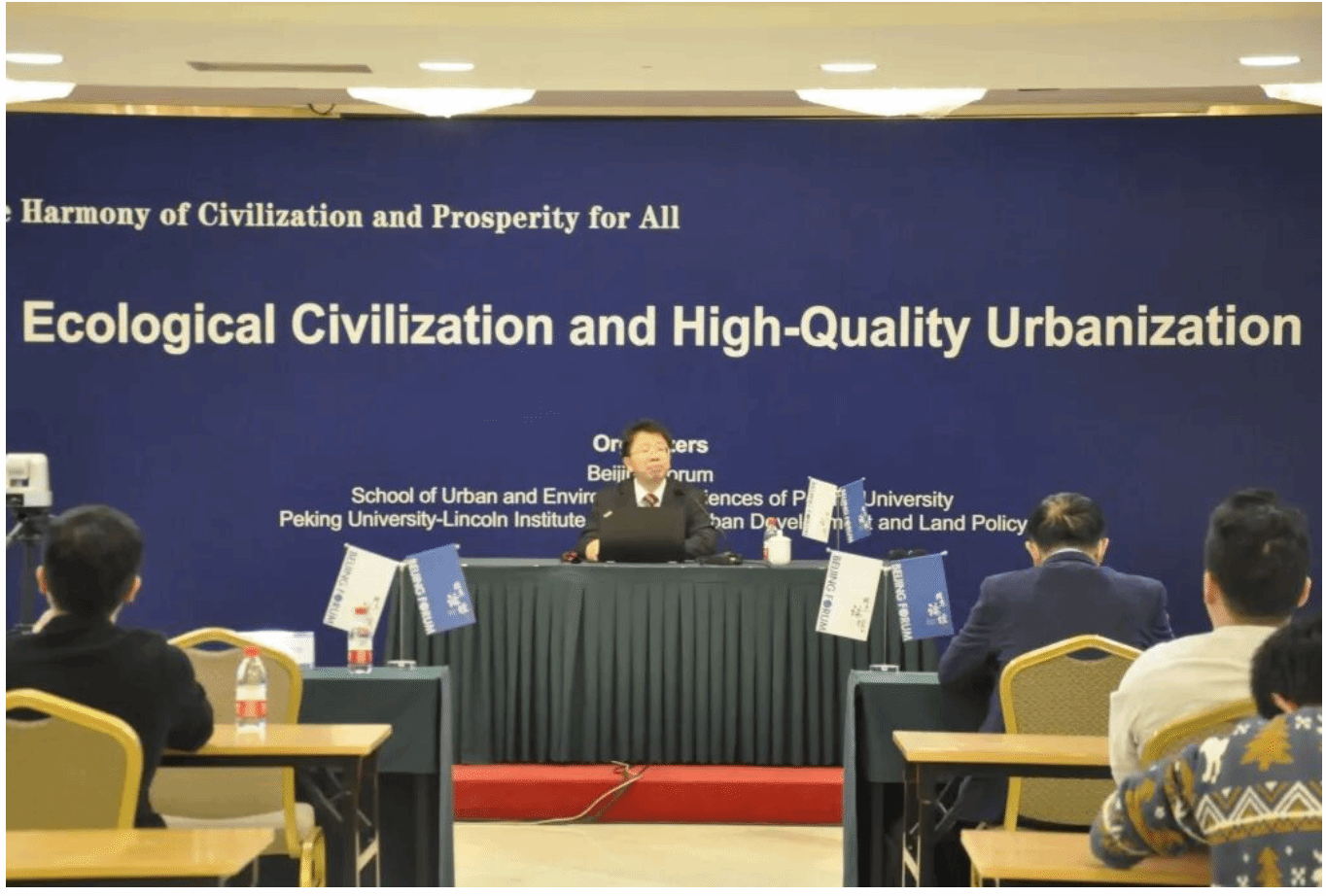
The conference was presided over by Professor Canfei He, Dean of the School of Urban and Environmental Sciences, Peking University. In his opening remarks, Professor He underscored the significance of high-quality urban development and noted that ecological perspectives would further advance this trend. He then invited Professor Ruth Defries from the Department of Ecology, Evolution and Environmental Biology, Columbia University, to deliver an online speech entitled Learning from Nature to Build Urban Ecological Civilization.

Drawing on her new book What Would Nature Do?, Professor Defries explored the relationship between humans — an urban species — and nature. She pointed out that urbanization took off after the Industrial Revolution, bringing new lifestyles and tremendous benefits alongside unforeseen complexities. She put forward two major solutions. First, build resilient urban networks. Natural evolution has formed intricate interconnected systems such as leaf vein networks, which can keep functioning and transporting nutrients even when partially damaged. Human societies should establish similar modular connection networks. Second, embrace the diversity of nature. Many species in nature are mutually replaceable, enabling ecosystems to survive major disasters. Against the backdrop of prevalent product homogenization today, diversity is essential to foster resilience. She also briefly introduced two other strategies: developing self-regulating mechanisms and adopting bottom-up decision-making processes.

Academician Bojie Fu from the Research Center for Eco-Environmental Sciences, Chinese Academy of Sciences, delivered the second keynote speech online, titled Ecological Civilization: Restoration and Management of China’s Ecosystems. Reviewing the evolution of human civilizations, he stressed that ecological civilization represents a historic transformation and a core national development strategy of China, rooted in the traditional Chinese philosophy of "harmony between humanity and nature". He elaborated on the Chinese Ecosystem Research Network (CERN) founded in 1988 and major national policies for ecosystem restoration, highlighting the importance of nationwide participation. Over the past decades, these efforts have yielded remarkable ecological progress and improved ecosystem services. Nevertheless, China still faces emerging ecological challenges including ongoing urbanization, excessive water consumption and the loss of coastal wetlands, calling for further ecological conservation work.

The third speaker was Professor Sanjeev Khagram, Dean and John D. and Catherine T. MacArthur Chair in Global Leadership and Political Economy at the Thunderbird School of Global Management, Arizona State University. His online presentation was entitled Leveraging the Data Revolution and the Fourth Industrial Revolution to Build Sustainable and Prosperous Cities. He first illustrated the roles of the data revolution and circular economy, and how cutting-edge technologies of the Fourth Industrial Revolution have reshaped cities and societies. He then discussed the definition and models of digitalization in the current era, which is transforming urban life and facilitating the construction of intelligent networks. Looking ahead, he noted that digitalization will enhance capacity to address major challenges such as climate change and generate innovative solutions. He suggested that sustainable and digital urban development should be prioritized over the next decade.

Professor Peng Gong, Dean of the School of Science and Chair of the Department of Earth System Science at Tsinghua University (who would later take office as Vice-Chancellor of the University of Hong Kong), gave an on-site speech themed Healthy Cities, Planetary Health and Ecological Civilization. Starting with the question of what future cities will look like, he compared urban scaling models from the United States with their practical application in China, arguing that it is necessary to explore universal laws governing urban scaling worldwide. He further defined healthy cities, analyzed major health challenges confronting Chinese cities, and shared experiences and lessons from national pilot projects for healthy city development. He emphasized that urban planning should integrate health considerations into decision-making. He then extended the concept to the global dimension of planetary health, and reaffirmed the value of systematic planning with real-world cases.

The final keynote speech was delivered by Professor Jintao Xu, Deputy Director of the National School of Development, Peking University, with the topic China’s Transition to a Green and Low-Carbon Economy. From the perspective of supply-side development, he analyzed China’s pursuit of high-quality economic growth. China gained opportunities for free market competition after its accession to the WTO in 2002, with exports becoming a key driving force for economic growth. However, the country’s rising GDP was accompanied by a sharp increase in carbon emissions. Based on carbon emission forecasting models, China’s carbon footprint expanded after WTO accession while that of its trading partners declined, indicating the existence of a pollution haven effect. In addition, although labor-intensive industries expanded rapidly, capital-intensive sectors reaped the greatest benefits and recorded the largest growth in carbon emissions. He concluded that WTO accession marked a turning point for China over the past two decades, and its export-oriented industries will undergo profound transformation in the next ten to twenty years. Relevant public policies should focus on rectifying distorted factor prices and introducing environmental taxes and carbon taxes.
After the keynote sessions, online and on-site audiences actively raised questions, which were answered in detail by the speakers.

Finally, Dr. Zhi Liu, Director of the Peking University–Lincoln Institute Center for Urban Development and Land Policy, delivered closing remarks. He recalled his previous participation in the Beijing Forum and expressed gratitude for the extensive support received despite the special circumstances this year. He summarized the key viewpoints of all speakers and thanked Professor Defries, Academician Fu, Professor Khagram, Professor Gong and Professor Xu for sharing cutting-edge research from diverse perspectives.
The forum attracted more than 5,000 online viewers, including a group of students organized by Hunan Normal University. Dr. Liu extended sincere thanks to the organizing team as well as all on-site and online participants, and announced the successful conclusion of the sub-forum.